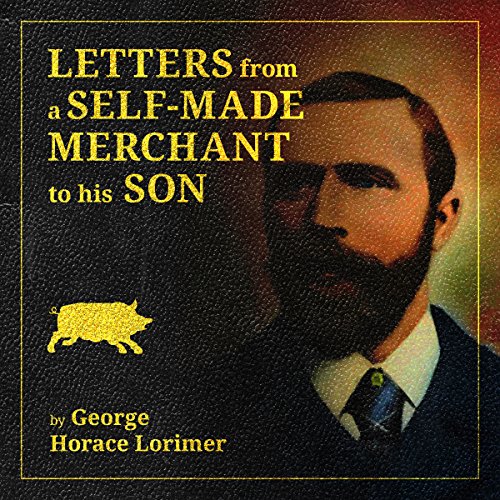
Twenty letters from a self-made merchant

Dear
Pierrepont,

John Graham writes to his son at Harvard and keeps writing after Pierrepont joins the family firm.

Listen to Letter I, free

01 / Letters I–V

College & the first job

01 / 20

Education and character

Pierrepont arrives at Harvard. His father has paid for an education and expects him to make use of it, in the classroom and outside it.

Scroll to open the letters ↓

Letter I: Education and character. Open letter.Fold letter.

From John Graham I

Dear Pierrepont,

“You bet it pays. Anything that trains a boy to think and to think quick pays; anything that teaches a boy to get the answer before the other fellow gets through biting the pencil, pays.”

02 / 20

Spending before earning

An alarming expense account arrives from college. Graham reminds his son that having a wealthy father is different from earning a living.

Next letter
Letter II: Spending before earning. Open letter.Fold letter.

From John Graham II

Dear Pierrepont,

“The sooner you adjust your spending to what your earning capacity will be, the easier they will find it to live together.”

03 / 20

From college to the packing-house

Pierrepont proposes a postgraduate course. His father offers him a job at the family packing-house.

Next letter
Letter III: From college to the packing-house. Open letter.Fold letter.

From John Graham III

Dear Pierrepont,

“Some men learn all they know from books; others from life; both kinds are narrow. The first are all theory; the second are all practice.”

04 / 20

Putting things off

A European holiday sounds more inviting than a first job. Graham ends the allowance and explains why getting started cannot wait.

Next letter
Letter IV: Putting things off. Open letter.Fold letter.

From John Graham IV

Dear Pierrepont,

“Putting off an easy thing makes it hard, and putting off a hard one makes it impossible.”

05 / 20

Knowing when to stop talking

A brief, sensible reply pleases Graham. He gives Pierrepont three rules for business conversation before sending him to work under Milligan.

Next letter
Letter V: Knowing when to stop talking. Open letter.Fold letter.

From John Graham V

Dear Pierrepont,

“Have something to say. Say it. Stop talking.”

02 / Letters VI–X

Learning the business

06 / 20

The cost of a careless letter

A private letter goes to a customer, and a business letter goes to a young woman. The mix-up costs the firm sixty dollars and earns Pierrepont a lesson in attention.

Next letter
Letter VI: The cost of a careless letter. Open letter.Fold letter.

From John Graham VI

Dear Pierrepont,

“You can resolve everything in the world, even a great fortune, into atoms. And the fundamental principles which govern the handling of postage stamps and of millions are exactly the same.”

07 / 20

Working under Milligan

Pierrepont complains about his boss. Graham describes the loyal man behind Milligan’s temper, then turns to self-respect and keeping one’s own temper.

Next letter
Letter VII: Working under Milligan. Open letter.Fold letter.

From John Graham VII

Dear Pierrepont,

“Remember that when you’re in the right you can afford to keep your temper, and that when you’re in the wrong you can’t afford to lose it.”

08 / 20

Getting on with the work

A promotion moves Pierrepont from mailing to billing. Writing from Hot Springs, Graham considers ambition, choosing work, and finding satisfaction before the finish line.

Next letter
Letter VIII: Getting on with the work. Open letter.Fold letter.

From John Graham VIII

Dear Pierrepont,

“The fun of the thing’s in the run and not in the finish.”

09 / 20

Fifty-two dollars’ worth of roses

A florist’s bill reaches the wrong Graham. Pierrepont’s courtship prompts his father to ask how a clerk’s wages will stretch to the life he is promising.

Next letter
Letter IX: Fifty-two dollars’ worth of roses. Open letter.Fold letter.

From John Graham IX

Dear Pierrepont,

“I knew right off that I had made a mistake when I opened the inclosed and saw that it was a bill for fifty-two dollars, “for roses sent, as per orders, to Miss Mabel Dashkam.””

10 / 20

Selling begins with listening

Pierrepont sets off on his first selling trip. His father warns him against arguing with customers and explains the judgment that should come before the pitch.

Next letter
Letter X: Selling begins with listening. Open letter.Fold letter.

From John Graham X

Dear Pierrepont,

“A real salesman is one-part talk and nine-parts judgment; and he uses the nine-parts of judgment to tell when to use the one-part of talk.”

03 / Letters XI–XV

Earning responsibility

11 / 20

Doing more than just enough

Selling costs barely pass muster. Graham wants more effort and a closer knowledge of the goods, especially from a salesman who thinks he already knows enough.

Next letter
Letter XI: Doing more than just enough. Open letter.Fold letter.

From John Graham XI

Dear Pierrepont,

“Nothing earns better interest than judicious questions, and the man who invests in more knowledge of the business than he has to have in order to hold his job has capital with which to buy a mortgage on a better one.”

12 / 20

Taking criticism, earning confidence

Pierrepont answers criticism with a wounded letter. His father asks for resilience, useful knowledge, and the tact to win a buyer’s confidence.

Next letter
Letter XII: Taking criticism, earning confidence. Open letter.Fold letter.

From John Graham XII

Dear Pierrepont,

“Tact is the knack of keeping quiet at the right time; of being so agreeable yourself that no one can be disagreeable to you; of making inferiority feel like equality.”

13 / 20

A raise, and a closer look

A good order earns a raise and a new suit. Graham talks about appearances, the scrutiny that comes with success, and why a polished manner needs checking against conduct.

Next letter
Letter XIII: A raise, and a closer look. Open letter.Fold letter.

From John Graham XIII

Dear Pierrepont,

“There’s nothing like trying a man in harness a while before you bind yourself to travel very far with him.”

14 / 20

A profitable mistake

Pierrepont makes money speculating in ribs. Graham orders him to give away the profit and draws a sharp distinction between selling actual goods and gambling on margin.

Next letter
Letter XIV: A profitable mistake. Open letter.Fold letter.

From John Graham XIV

Dear Pierrepont,

“When a speculator wins he don’t stop till he loses, and when he loses he can’t stop till he wins.”

15 / 20

Before taking charge

An assistant manager’s job awaits. Graham sets out what Pierrepont must know about the product, himself, and the people he will manage.

Next letter
Letter XV: Before taking charge. Open letter.Fold letter.

From John Graham XV

Dear Pierrepont,

“No man can ask more than he gives. A fellow who can’t take orders can’t give them.”

04 / Letters XVI–XX

A life beyond the office

16 / 20

The society bug

News of Pierrepont’s social ambitions reaches his father in Karlsbad. Graham tells a story about buying one’s way into society and questions the value of inherited status.

Next letter
Letter XVI: The society bug. Open letter.Fold letter.

From John Graham XVI

Dear Pierrepont,

“A man’s as good as he makes himself, but no man’s any good because his grandfather was.”

17 / 20

Let the work speak

Pierrepont reports how well he is doing in his new job. Graham hopes the boss agrees, and recalls a childhood lesson in the embarrassment of showing off.

Next letter
Letter XVII: Let the work speak. Open letter.Fold letter.

From John Graham XVII

Dear Pierrepont,

“A man who does big things is too busy to talk about them. When the jaws really need exercise, chew gum.”

18 / 20

Rumors and worry

Newspaper reports suggest that Graham is in trouble in the lard market. He reassures his son, dismisses flattery and abuse, and considers the work people make of worrying.

Next letter
Letter XVIII: Rumors and worry. Open letter.Fold letter.

From John Graham XVIII

Dear Pierrepont,

“There are two things you never want to pay any attention to—abuse and flattery. The first can’t harm you and the second can’t help you.”

19 / 20

Who is Helen Heath?

Graham meets Helen on the Atlantic crossing and suspects his son has something to tell him. Advice about choosing a wife follows, with money very much in the conversation.

Next letter
Letter XIX: Who is Helen Heath?. Open letter.Fold letter.

From John Graham XIX

Dear Pierrepont,

“Money ought never to be the consideration in marriage, but it always ought to be a consideration.”

20 / 20

The old man’s blessing

Graham approves the engagement. His parting letter mixes dated views on marriage with memories of his own early household and a plea to enjoy life as it happens.

Hear the complete book
Letter XX: The old man’s blessing. Open letter.Fold letter.

From John Graham XX

Dear Pierrepont,

“With most people happiness is something that is always just a day off. But I have made it a rule never to put off being happy till to-morrow.”

The subject headings and summaries are ours. The passages are Lorimer’s original text, first published in 1902.

The book and recording contain dated attitudes, language, and racial slurs.

The unabridged audiobook

Hear them in his voice.

Letters from a Self-Made Merchant to His Son, by George Horace Lorimer.
Read by Alan Taylor · 4 hours, 2 minutes
English · Published by Erik Holland, 2017

Get the audiobook on Audible